


Quality over quantity starts with the small details
Sealants and adhesives are among the few materials that touch nearly every transition in a house: windows, doors, stucco, siding, glass, tile and stone. They are also easy to get wrong, because two products that look alike on the shelf can behave very differently once they cure.
This guide explains how the main sealant chemistries work, how to read the numbers on a technical data sheet, and how to match a product to the joint in front of you. The examples come from Premier’s XtraBond® line, but the principles apply to any sealant you spec.
How sealants work: the main chemistries
Most construction sealants are one-component products that cure by reacting with moisture in the air. What differs is the polymer, and the polymer decides flexibility, paintability, odor, cleanup and the surfaces a sealant bonds to.
| Chemistry | What it does well | Limits to know | Typical joints | XtraBond example |
|---|---|---|---|---|
| 100% RTV silicone | Stays flexible, resists mildew and UV | Not paintable; check compatibility on stone and some metals | Tubs, showers, sinks, glass, tile | XB250, XB150 |
| Neutral cure silicone | Low odor, bonds to glass and coated metals without primer | Not paintable | Glazing, back bedding, glass replacement | XB450 |
| Acrylic latex | Water cleanup, paintable | Best in dry interior joints | Interior trim and painted joints | XB25, XB50, XB100 |
| Advanced polymer | Paintable, no solvents, low VOC, bonds to many substrates | Check the data sheet for substrate approvals | Windows, doors, stucco, siding | XB9500, XB9500TX, XB9550 |
| Liquid applied flashing | Forms a flexible waterproof seal at openings | Non-sag; confirm approved joints on the data sheet | Window and door perimeters, expansion joints | XB9714 |
Reading a spec sheet: what the numbers mean
A technical data sheet answers most selection questions, if you know what each line tells you.
| Spec | What it tells you | Example from XtraBond data sheets |
|---|---|---|
| Movement capability (ASTM C719) | How far a joint can stretch and compress, as a percentage of its width. On a ½" joint, ±35% is about 0.175" each way. | XB450: ±35%; XB150: ±25%; XB9500: ±25% |
| ASTM C920 classification | The standard for elastomeric joint sealants. Type S is single component, Grade NS is non-sag, the Class number is movement capability, and Use letters (NT, G, A, M) name the substrates and conditions tested. | XB250: Type S, Grade NS, Class 25 |
| UV resistance (ASTM G154) | Whether color and surface hold up under accelerated sun exposure. | XB450: no discoloration after 2,500 hours |
| Temperature range | Application range tells you when you can install; service range tells you what the cured joint can take. | XB9500: applied from -40°F to 140°F; XB450 service range -40°F to 350°F |
| VOC (EPA Method 24) | Grams per liter of volatile organic compounds, which matters for indoor air quality. | XB9500TX: under 13 g/L; XB250: under 23 g/L |
| Skin, tack-free and cure time | When you can tool the bead, when it stops feeling sticky, and when a ¼" bead is fully cured. | XB250: skin under 20 min, cure in 36 hours |
| Approvals and certifications | Verified suitability for a use or substrate. | AAMA 714 (liquid applied flashing), NSF/ANSI 51 (food equipment materials), approved for cultured marble |
Matching chemistry to the joint
The joint, not the brand, should drive the choice. Start with what the joint touches and what it faces: water, sun, movement, paint.
One rule of thumb: if a joint will be painted, rule out the silicones, which are not paintable. If it will sit in constant water, rule out acrylic latex.
| Joint | Chemistry that fits | Why | XtraBond examples |
|---|---|---|---|
| Window and door perimeters | Advanced polymer, silicone or liquid applied flashing | Adhesion to frames and substrates, plus a sealed opening | XB9500TX, XB450, XB150, XB9714 |
| Stucco, siding and exterior joints | Advanced polymer or liquid applied flashing | Paintable, flexible, wide application range | XB9500, XB9500TX, XB9714 |
| Glass, glazing and coated metal | Neutral cure silicone | Adhesion to glass and Kynar™ coatings, UV resistance, low odor | XB450 |
| Kitchens and baths | 100% silicone | Mildew resistance and flexibility where water sits | XB250, XB150 |
| Rough openings and expansion joints | Liquid applied flashing | Flexible, non-sag waterproof seal | XB9714 |
| Painted interior trim | Acrylic latex | Paintable, water cleanup | XB25 |
Why joints fail: the most common causes
Most failures are installation or selection problems, not product defects. The same few causes show up again and again.
- Poor surface preparation. Dirt, oils, grease and leftover incompatible sealer keep a bead from bonding.
- The wrong chemistry for the joint. For example, an acrylic latex in constant water, or a silicone where the joint will be painted.
- Untested substrates. Stone, coated metals and unfamiliar finishes can react with a sealant. A small test area catches problems before the whole job is done.
- Ignoring movement. A joint that moves more than the sealant allows will tear or pull away. Compare the joint’s expected movement with the sealant’s rating.
- Tooling too late. Once a bead skins over, tooling tears it instead of smoothing it. Know the skin time for the product.
- Water or movement before cure. A bead that is wet or flexed before it has cured can lose adhesion.
Application checklist
These steps follow the directions on Premier’s data sheets and apply to most one-component sealants.
- Prepare the surface. It must be clean, frost-free and free of oils, greases and incompatible sealers. Remove old sealant and residue.
- Test the substrate. Try the sealant on a small, hidden area first.
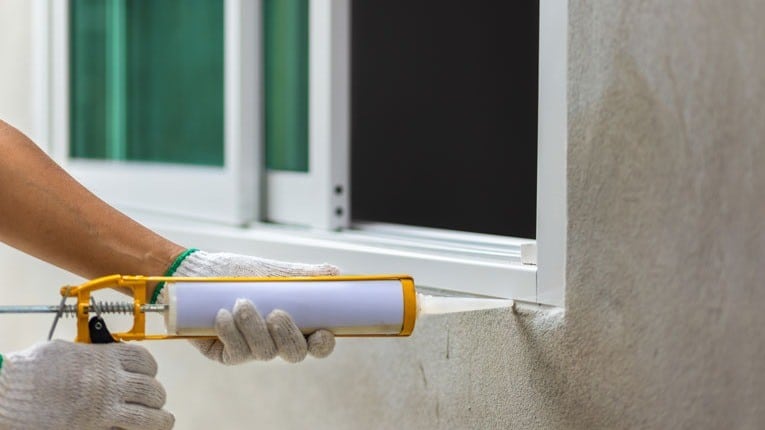
- Cut the nozzle to the bead size the joint needs and apply a continuous bead with a caulking gun.
- Tool within the skin time. Skin times on XtraBond® data sheets run from under 15 to under 25 minutes at 70°F and 50% relative humidity.
- Clean excess promptly with mineral spirits or a similar solvent, or with water for acrylic latex.
- Allow full cure. A ¼” bead cures in about 36 to 48 hours for the silicones and advanced polymers listed here. Keep water and movement away until then.
- Store cartridges correctly. Keep them dry, below 75°F and never frozen, and use them within the shelf life on the data sheet.
Takeaways
- Choose by joint first: what it touches, what it faces and how much it moves.
- Read the data sheet for movement capability, ASTM C920 class, UV hours, VOC, cure time and approvals.
- Prepare, test and tool: most failures start with a skipped step, not a bad product.
Technical data sheets and safety data sheets for each XtraBond® product are available at https://premierbuildingsolutions.net/support/literature/. For technical questions, call Premier Building Solutions at 866-512-4583.
Always follow the product’s technical data sheet and test substrates before use. Premier Building Solutions makes no warranties about product performance in any given application.




Leave A Comment